

 John P. Gleason
These are two magnificent images of the Orion consellation of stars as well as a close-up of the M42 nebula that is the center of Orion's scabbard. Astronomers tell us this is only 1,500 light-years away and one of the most famous star nurseries in the detectable universe.
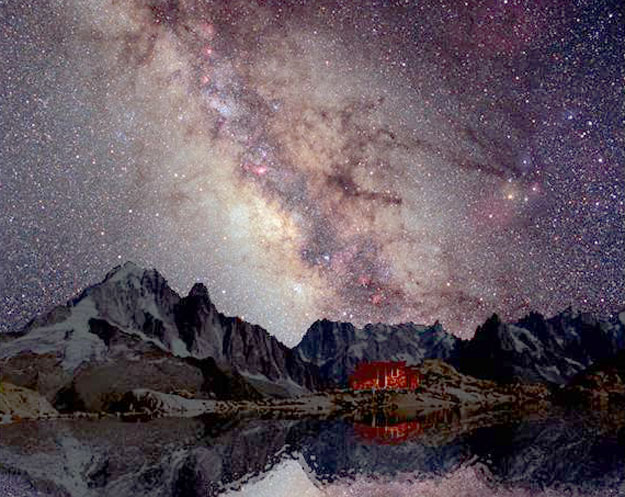
Credit & copyright: Marc Sylvestre.
There are three purposes for this incredile image of the Home Galaxy -- The Milky Way -- over Mont Blanc, the highest mountain in Europe:
1.) for all of us who have spend countless hours laying on the ground in awe and wonderment of the band of stars we call the Milky Way.
2.) to acknowledge the incredible imagination and technical expertise of the photographer, Marc Sylvestre, who syncronized his camera with the Earth's rotaton for the long duration exposure to capture the amazing starfield, and then a short exposure of the mountain scene at moonrise to illuminate the Earth scene.
3.) to recognize and link to the Astronomy Picture of the Day website

Somehow Cap's photographs of the Comet Hale-Bopp disappeared. Now, we only have to wait 4,300 years to see it again. It was spectacular in the Northern hemisphere where is was closest to the Sun. How could anyone see that magnificent comet in smears across the sky and not wonder what else is out there? Space travel is as much a necessity as exploring the oceans or the complexity of the human genome. Cap finally found a good photograph of Hale-Bopp for this section.
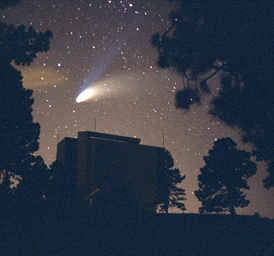
This is the best Earth observation photograph of the Comet Hale-Bopp, taken overhead the Apache Peak Observatory in New Mexico, USA. Thank you, Ms. Gloria.
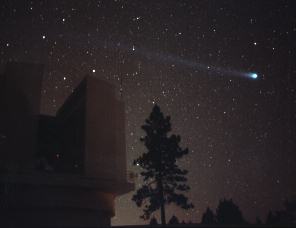
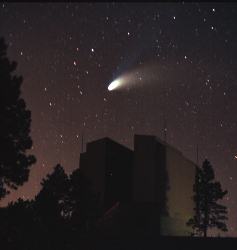 Comet Hale-Bopp, 1997
These are two great comparative photographs of two incredibly significant astronomical events -- the Comets Hyatutake and Hale-Bopp. Compared side-by-side, they are distinctively different objects. Like Ms. Gloria's photograph of Comet Hale-Bopp above, both these photographs were taken over New Mexico State University's Apache Peak Observatory.

This is the Comet Halley nucleus. A rather dramatic photograph, probably one of the best close-ups of a comet nucleus. The Halley nucleus is about 2 miles across. The Hale-Bopp nucleus, for contrast, is about 25 miles across...a rather hefty chunk of ice & dirt.
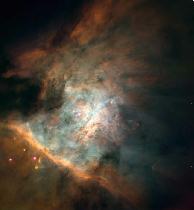
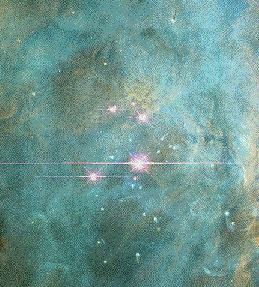
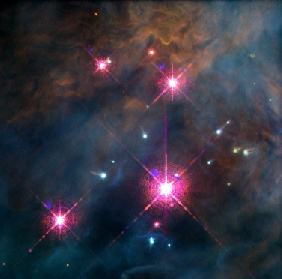
These photographs are from the M42 Orion Nebula. The enlargements progress to the right from the center of the previous image. The Trapezium stars are four massive stars within the Orion Nebula, believed to be the most prolific star and proto-planetary nursery in the Universe. The area of space is widely studied for many reasons, but most notably in Cap's opinion, for the possibility of other planetary system
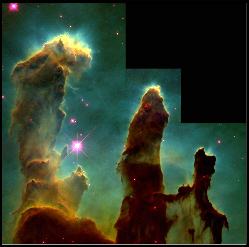
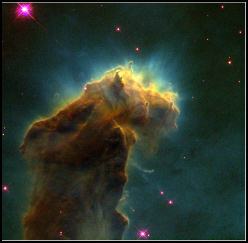
These photographs are of the M16 Eagle Nebula, in the Constellation Serpens. This has to be one of the most spectacular space photographs to date. Can you imagine what it would be like to travel to this distant place?
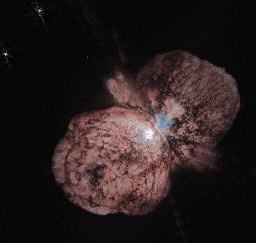
This spectacular photograph is the dying star, Eta Carinae, in the Carina Constellation of the Southern Hemisphere. Hey, it is only about 3,700 light-years from Earth. Even at Warp 9, it would take too long to get there. The wonders brought to us by the Hubble Space Telescope have only just begun.

